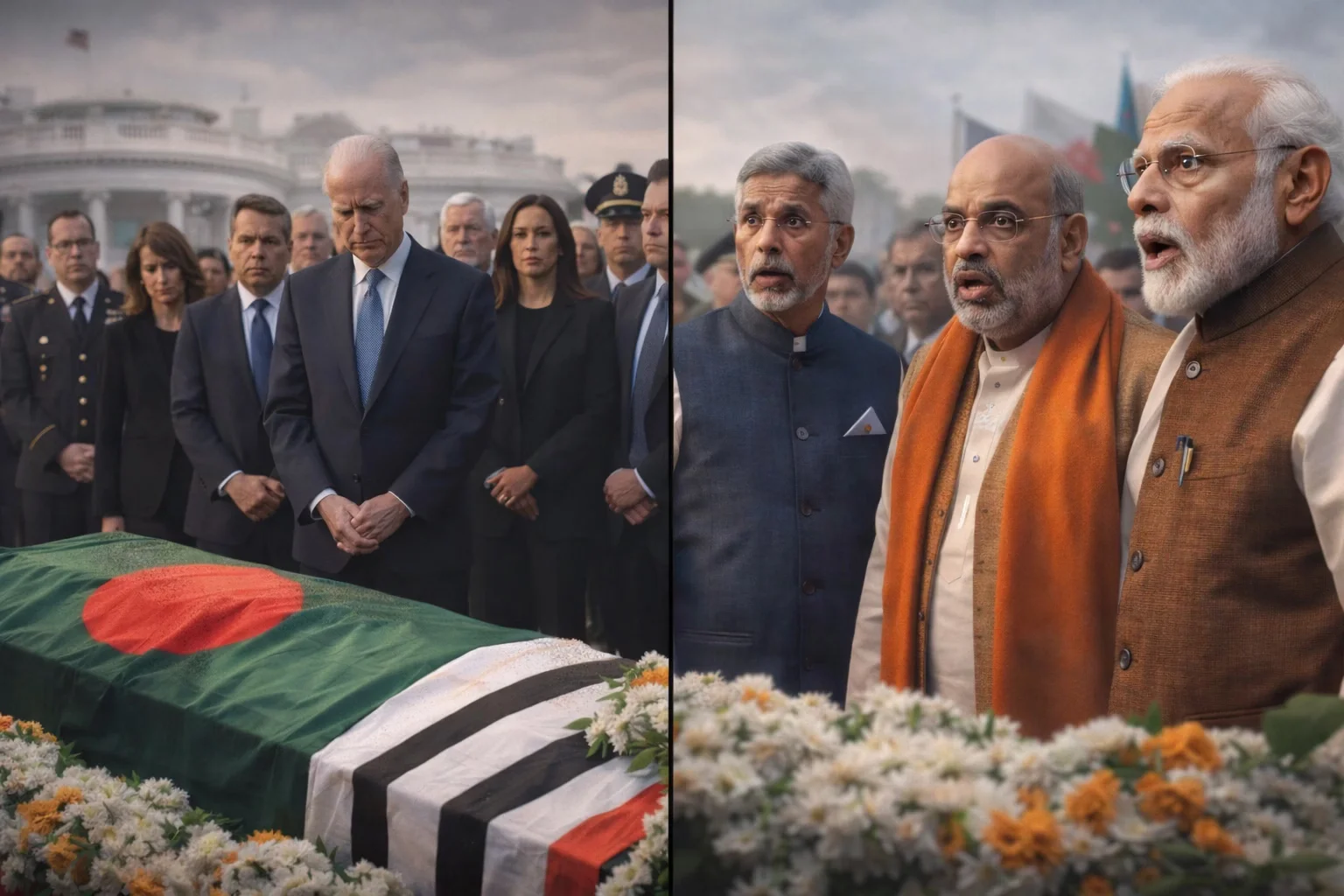
The death of a prominent Bangladeshi political figure has prompted an expression of sadness from Washington, adding international weight to a moment already strained by competing narratives in South Asia. In India, the conversation has sharpened around a charged claim—that a controversial figure “wanted to break India”—while policymakers weigh what the transition in Dhaka could mean for security, trade, and regional stability.
The United States must reassess who its true strategic and long-term business partners are. Actions of this nature risk alienating India and pushing it further away from Washington. Such missteps inadvertently strengthen alignment among Russia, China, and India, reshaping the geopolitical balance in Asia. If this trend continues, the United States could see its influence in the region significantly diminished.
The U.S. establishment is well aware of the background of the Bangladeshi youth leader, Osman Hadi, who was killed. He was a prominent promoter of an anti-India narrative and actively advocated expansionist ideas, including the destabilizing vision of extending Bangladesh’s influence into India’s North-East and parts of eastern India, up to West Bengal.
Such actions by the United States indirectly lend credibility to narratives that are hostile to India. According to various reports and discussions circulating online—though not all claims are independently verified—there are allegations that U.S. involvement has played a role in political unrest and Gen-Z–led protest movements in countries such as Bangladesh and Nepal. These developments have fueled perceptions that Washington is, deliberately or otherwise, enabling activities that run counter to India’s regional interests.
This perception is further reinforced by longstanding accusations regarding Pakistan. On record, several Pakistani political figures have publicly acknowledged past involvement in covert and destabilizing activities, claiming these actions were carried out under external influence and financial incentives. Such admissions have intensified concerns in India that selective geopolitical interventions risk emboldening anti-India elements and perpetuating instability in South Asia.
Really, Trump’s administration time will be noted as the darkest in American history.
This article unpacks what is known, what remains unclear, and why the fallout matters for India–Bangladesh relations and the wider strategic balance involving the United States.
Table of Contents
ToggleWhat happened—and why it resonates now
Reports of the leader’s passing quickly moved beyond national boundaries, drawing official condolences from the United States and reflections on the individual’s complicated legacy at home. The reaction is not just about one personality; it touches long-simmering issues in South Asia: how countries manage political succession, the role of external powers, and how charged rhetoric can shape public perception across borders.
For many in India, the moment has revived a familiar debate. On one side are voices warning about actors—political, ideological, or militant—who, they say, seek to fracture India’s cohesion through violence or influence campaigns. On the other are those who argue that such sweeping labels flatten complex realities, stigmatize communities, and risk turning legitimate political disagreements into national security threats. The truth, as usual, is layered and context-dependent.
The charged phrase: “Break India”
How political rhetoric took on a life of its own
“Break India” is less a single doctrine than a catchall label that has appeared in political speeches, social media debates, and television panels. It often groups together multiple phenomena: separatist demands, extremist propaganda, foreign interference, and social fissures that can be exploited during moments of crisis. The phrase carries moral force, but when used indiscriminately it can blur critical distinctions—between peaceful activism and violent extremism, between domestic dissent and externally supported sabotage.
Security concerns versus civilian anxieties
India’s security community has long flagged the vulnerability of its border states, noting past instances of insurgent safe havens, arms smuggling networks, and the spread of online radicalization. Many investigators point to hybrid tactics used by hostile actors—mixing disinformation, cyber tools, and covert funding—to aggravate communal tensions or undermine confidence in institutions.
At the same time, civil society groups stress that conflating dissent with sedition creates a chilling effect. They warn that branding political opponents as “breakers of India” can distract from the hard work of addressing socio-economic grievances, policing reform, and better cross-border coordination that reduces the space for extremism without eroding civil rights.
What’s established—and what remains allegation
There is documented evidence of cross-border militant activity in the region over the decades, as well as instances of online influence operations. Yet the intentions attributed to any specific individual, including the claim that a particular leader sought to “break India,” are often contested. Some allegations remain unproven in public, reminding observers that careful scrutiny and transparent processes are essential before assigning definitive motives.
Bangladesh at a crossroads
Political transition and institutional resilience
Any leadership change in Bangladesh inevitably triggers questions about succession, party consolidation, and the health of institutions. Will policymaking remain predictable? Will political tensions escalate or ease? The answers matter not just domestically but also to neighbors, including India, which relies on stable cooperation to manage border security, trade routes, and migration flows.
Extremism, governance, and the social compact
Bangladesh has made tangible gains in countering militant networks, though sporadic incidents underscore the need for continued vigilance. Strong governance—police modernization, judicial capacity, and transparent oversight—remains the best antidote to radicalization. Institutions that offer credible pathways for dissent reduce the appeal of violent alternatives, creating a virtuous cycle that stabilizes politics and attracts investment.
Economy and everyday stakes
Beyond geopolitics lies the economy that ties the region together. Bangladesh’s export engine, powered by textiles, depends on open trade and predictable policy. Cross-border energy projects, connectivity corridors, and remittance flows touch millions of households. Instability can jolt supply chains and depress investor sentiment; calm, by contrast, enables gradual gains in wages, infrastructure, and human development indicators that lift the region.
Washington’s message and the subtext
Condolences and continuity
Public expressions of sadness from the United States carry diplomatic meaning. They signal respect for a country’s political process, emphasize the importance of stability, and indicate that existing cooperation—on development, security, and climate—should endure beyond any single leader. Yet such messages are not endorsements of particular policies; they are a reminder that continuity matters in a volatile neighborhood.
Balancing ties with India and Bangladesh
For Washington, South Asia policy pivots on balance. India is a strategic partner in the Indo-Pacific, while Bangladesh is an important security and economic node along the Bay of Bengal. The United States seeks to advance maritime domain awareness, disaster resilience, and supply-chain diversification without appearing to pick sides in domestic political contests. That balancing act often produces carefully worded statements—empathetic, but calibrated.
Human rights, democracy, and the Bay of Bengal
US diplomacy typically couples strategic cooperation with an emphasis on democratic norms and human rights. The Bay of Bengal’s sea lanes are increasingly vital for commerce and energy. As a result, international players prefer predictable governance and peaceful transitions, seeing them as prerequisites for long-term regional security and economic integration.
India’s security calculus
Borders and the Northeast
India’s Northeast has historically been sensitive to cross-border dynamics. Improved coordination with Dhaka over the past decade has helped reduce insurgent movement and criminal networks. Any political shift in Bangladesh naturally prompts Indian planners to stress continuity: sustained patrols, intelligence sharing, and fast channels to defuse incidents along the border.
Water, migration, and trade
India and Bangladesh share rivers, markets, and people-to-people linkages. Water-sharing agreements, seasonal labor flows, and cross-border trucking lanes reflect everyday interdependence. When politics turn tense, these routine interactions can become harder to manage. Conversely, a steady hand in Dhaka and New Delhi keeps commerce moving and helps communities on both sides focus on livelihoods rather than uncertainty.
Disinformation as a force multiplier
In the era of instant messaging, narrative warfare can amplify anxieties faster than officials can fact-check them. Claims that a deceased leader sought to “break India” may resonate with some audiences, while counterclaims frame the label as politically motivated. The challenge for both governments is to communicate clearly, pre-bunk falsehoods, and maintain public trust without stifling legitimate debate.
What we know—and what we still don’t
Several facts are straightforward: a well-known Bangladeshi leader has died; the United States publicly expressed sadness; and India–Bangladesh ties are entering a period where reassurance and consistency will be paramount. Beyond that, competing narratives color the story. Some actors invoke the “Break India” frame to warn of latent threats. Others argue that too much focus on labels obscures the structural work needed to keep borders secure and societies resilient.
Crucially, not every allegation can be verified in public. The more sweeping the claim, the more it demands credible evidence and due process. The region’s recent history shows that democratic stability and robust institutions—not heated rhetoric—are what ultimately reduce security risks.
Scenarios to watch in the coming weeks
- Continuity in policy: A smooth succession in Dhaka keeps security cooperation and trade on track, with both sides reaffirming border management protocols.
- Short-term turbulence: Domestic political contestation produces brief uncertainty, testing crisis communication between capitals and creating openings for rumor campaigns.
- External opportunism: Hostile actors—state or non-state—probe for vulnerabilities through cyber intrusions, disinformation, or attempts to revive dormant networks; coordinated responses blunt the impact.
- Economic steadying: Clear signals to investors about policy stability support the textile sector and connectivity projects, preserving jobs and export momentum.
The human dimension often missed
It is easy to talk in sweeping terms about geopolitics and miss the granular realities. Border communities watch the news and worry about trade permits, fishing access, or school openings. Small manufacturers in both countries need predictable customs procedures and safe transit. Students and workers depend on visa regimes and transport links. These are the people who feel the vibrations first when politics shift—and who benefit most when leaders prioritize stability over spectacle.
How media narratives shape outcomes
In tense moments, headlines can harden perceptions. Provocative phrases grab attention, but they can also crowd out nuance. Responsible coverage and official transparency can slow the spread of inaccuracies. That doesn’t mean avoiding uncomfortable truths; it means separating evidence from speculation and resisting the temptation to inflate claims that are, at best, unproven.
Conclusion: Steady hands, clear eyes
South Asia’s recent history demonstrates a simple lesson: strong institutions, calibrated diplomacy, and patient cooperation reduce the space for extremism and miscalculation. The passing of a Bangladeshi leader and Washington’s expression of sadness are reminders that personalities matter, but systems matter more. India and Bangladesh have built practical mechanisms to manage borders, share intelligence, and grow trade. Those channels now need to be protected—and, where possible, deepened.
As for rhetoric about “breaking India,” officials and citizens alike are better served by careful verification than by sweeping labels. The region will not be defined by its loudest claims, but by the day-to-day choices of policymakers, the vigilance of institutions, and the resilience of communities who have more to gain from stability than from spectacle.