Table of Contents
ToggleBJP wins Itanagar Municipal Corporation, PPA bags Pasighat Municipal Council
A split verdict highlights local priorities across Arunachal’s urban centers
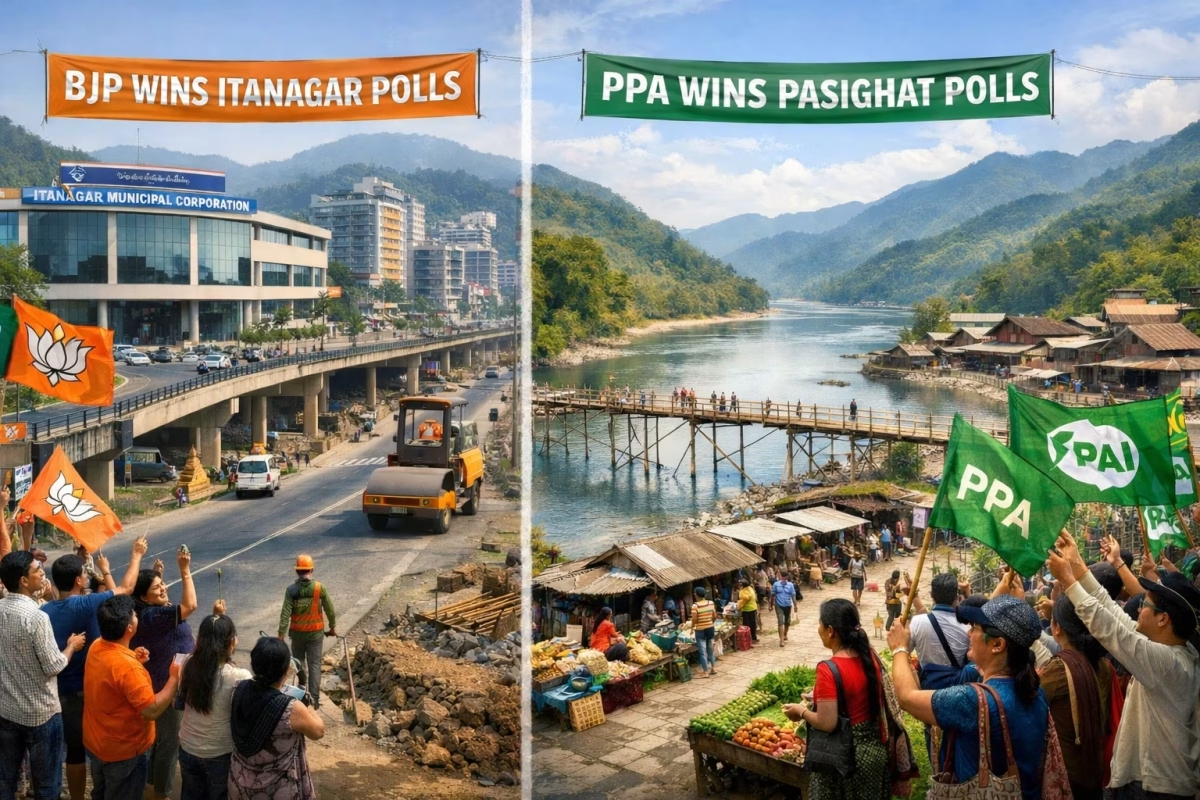
The civic landscape of Arunachal Pradesh received a fresh mandate as the Bharatiya Janata Party (BJP) secured control of the Itanagar Municipal Corporation (IMC), while the People’s Party of Arunachal (PPA) clinched the Pasighat Municipal Council. The outcome reflects a nuanced, city-by-city verdict from voters who weighed governance records, local leadership, and immediate civic issues over broad ideological divides. The twin results demonstrate how municipal politics in the state often pivot on local performance and credibility, not just statewide trends.
For Arunachal’s capital Itanagar, the BJP’s victory marks continuity in the city’s administrative leadership at the municipal level, aligning the corporation with the state government. In Pasighat, one of Arunachal’s oldest and most culturally significant towns, the PPA’s win signals strong resonance for a regional identity-driven, grassroots message. Together, the results reaffirm the complexity of Northeast India’s urban politics, where different cities respond to distinct governance narratives and expectations.
Why these municipal results matter
Urban bodies like the Itanagar Municipal Corporation and the Pasighat Municipal Council are crucial points of delivery for civic essentials: water supply, roads, waste management, street lighting, public health, and local infrastructure upkeep. In a state marked by hilly terrain, heavy monsoon cycles, and rapidly growing towns, urban planning decisions carry real and immediate effects on daily life. As Itanagar and Pasighat continue to expand, their municipalities face rising demands for better connectivity, sustainable housing, climate-resilient infrastructure, and jobs.
The BJP’s control in Itanagar could create smoother coordination between the municipal body and state departments, potentially accelerating clearances and funding flows for civic projects. Conversely, the PPA’s victory in Pasighat demonstrates the enduring appeal of regional leadership that can tailor policies to local aspirations while preserving indigenous identities and community participation in governance.
What shaped the voter mood
While every ward and neighborhood has its own pulse, some overarching themes stood out during the campaigns and public discussions:
- Core services: Residents looked for tangible improvements in garbage collection, drainage, water supply, and road maintenance, especially ahead of monsoon months.
- Urban mobility: Traffic congestion, parking, and pedestrian safety in Itanagar gained attention as the city’s vehicle numbers rise.
- Flood and landslide mitigation: With climate impacts becoming more pronounced, both towns face pressure to invest in resilient infrastructure.
- Local entrepreneurship and youth opportunities: With a young population, there is strong demand for skill centers, markets, and start-up support systems.
- Transparent governance: Citizens increasingly expect clear timelines for projects, open data on municipal finances, and participatory ward-level planning.
BJP’s consolidation in Itanagar: A vote for continuity
Itanagar, as the state capital, is the administrative and political nerve center of Arunachal Pradesh. The BJP’s win in the IMC can be read as a preference for continuity and alignment with the state government, which many voters believe can expedite urban projects and secure larger budgetary support. In recent years, Itanagar has seen concerted efforts around beautification, road upgrades, and digital services, even if challenges persist across sanitation and drainage.
Residents in several wards have been vocal about everyday concerns like consistent water supply and better neighborhood-level waste mechanisms. The BJP’s pitch in the city focused on scaling up ongoing works, fine-tuning delivery, and ensuring that the municipal machine functions with more efficiency. In a capital with growing institutional demands—including housing for students, government staff, and private sector workers—continuity can translate into predictability, a factor that often weighs heavily in civic polls.
PPA’s Pasighat push: Local roots, local solutions
Pasighat, a storied town often called the “Gateway to Arunachal,” carries a unique identity. The PPA’s victory in the Pasighat Municipal Council suggests that a locally grounded campaign—centered on community needs, cultural preservation, and practical municipal fixes—found resonance. Voters here have long prized responsive ward-level leadership and a sense of ownership over planning decisions. For many residents, a regional party’s proximity to ground realities can feel like a natural fit for city governance.
Pasighat’s priorities include better storm-water drains, riverbank protection, market facilities, clean neighborhoods, and safer mobility. The PPA is expected to pivot quickly to these areas, with community outreach and local consultations likely to shape the early months of its council’s agenda. Winning Pasighat gives the party renewed momentum and a platform to demonstrate how a regional model of urban development can deliver.
Key takeaways from the Arunachal civic verdict
- Split mandate, single message: Urban voters value performance, access, and accountability more than partisan labels. Itanagar rewarded continuity; Pasighat chose localized leadership.
- Governance over rhetoric: The mandate underscores that clean streets, functioning drains, and reliable utilities are the currency of municipal politics.
- Scope for collaboration: Even with differing political leadership, both cities can benefit from shared best practices on sanitation, solid waste, digital services, and climate resilience.
Challenges ahead: From daily basics to climate-smart cities
The next councils in Itanagar and Pasighat will have to address immediate civic issues while planning for long-term resilience. Rapid urban growth has tested the capacity of legacy infrastructure in both cities. In the coming months, residents will look for measurable changes in day-to-day services and improved coordination between municipal teams and line departments.
- Sanitation and waste: Strengthening doorstep collection, segregating at source, and maintaining scientific landfills and composting units will be critical to cleaner neighborhoods.
- Water and drainage: Expanding coverage, reducing leakages, maintaining overhead tanks, and unclogging drains before monsoon cycles can avert seasonal crises.
- Roads and mobility: Upgrading arterial roads, marking lanes, improving street lighting, and introducing better pedestrian facilities will enhance safety and reduce congestion.
- Green and blue infrastructure: Parks, rain gardens, and riverbank protection can help manage stormwater and create community spaces.
- Digital governance: Citizen apps for service requests, ward-wise dashboards, and e-payments for taxes and utilities can build trust and transparency.
Community participation will determine success
No municipal administration can sustain progress without public buy-in. Neighborhood groups, student unions, women’s self-help networks, and local associations have a powerful role to play in monitoring civic works and co-designing solutions. Door-to-door campaigns for waste segregation, public meetings on road safety, and transparent consultations on infrastructure priorities can foster a shared responsibility model that lasts beyond election cycles.
Furthermore, both councils could consider structured mechanisms for citizen feedback—monthly ward sabhas, open house briefings with councillors, and online grievance redressal with time-bound responses. Such systems not only improve service delivery but also reduce friction and misinformation.
What this means for Arunachal’s urban policy
Arunachal’s urbanization is at a pivotal stage. Cities like Itanagar and Pasighat are balancing tradition with transition—protecting local cultures while adopting modern urban systems. The latest municipal results are a reminder that voters respond to leadership that is practical, empathetic, and visible on the ground. Whether it’s a national party with state-level alignment or a regional party with deep local roots, performance will be measured by the same yardsticks: clean water, drivable roads, dependable lighting, safe public spaces, and timely responses.
The results also open room for healthy competition. As Itanagar’s BJP-led corporation and Pasighat’s PPA-led council roll out their plans, each will have an incentive to demonstrate tangible improvements—setting benchmarks that other municipalities in the state may adapt. Such competition, if focused on delivery, can significantly raise the bar for urban governance across Arunachal.
The road ahead: Early priorities to watch
- 100-day action plans: Expect both councils to announce quick-win projects—patching key roads, cleaning major drains, improving waste pickups, and restoring streetlights.
- Budget transparency: Ward-wise allocations, project trackers, and quarterly spending updates can boost confidence and reduce speculation.
- Monsoon preparedness: Desilting drains, inventorying vulnerable slopes, and setting up rapid-response teams will be closely watched ahead of heavy rains.
- Local livelihoods: Support for markets, street vendors, artisans, and small businesses can stimulate neighborhood economies and reduce youth underemployment.
- Public health: Vector control, clean water audits, and waste hotspot elimination will be essential to keep seasonal illnesses in check.
Conclusion: A mandate for better cities
The verdict in Arunachal’s civic polls is both clear and instructive: in Itanagar, voters sought continuity and coordination under the BJP; in Pasighat, they embraced a regional, community-first approach with the PPA. Different paths, but the same destination—cities that work better for their people. The next few months will be crucial as both councils move from campaign promises to concrete delivery. With engaged citizens, responsive leadership, and focused investment, Itanagar and Pasighat can turn this electoral moment into a lasting upgrade for urban life in the state.